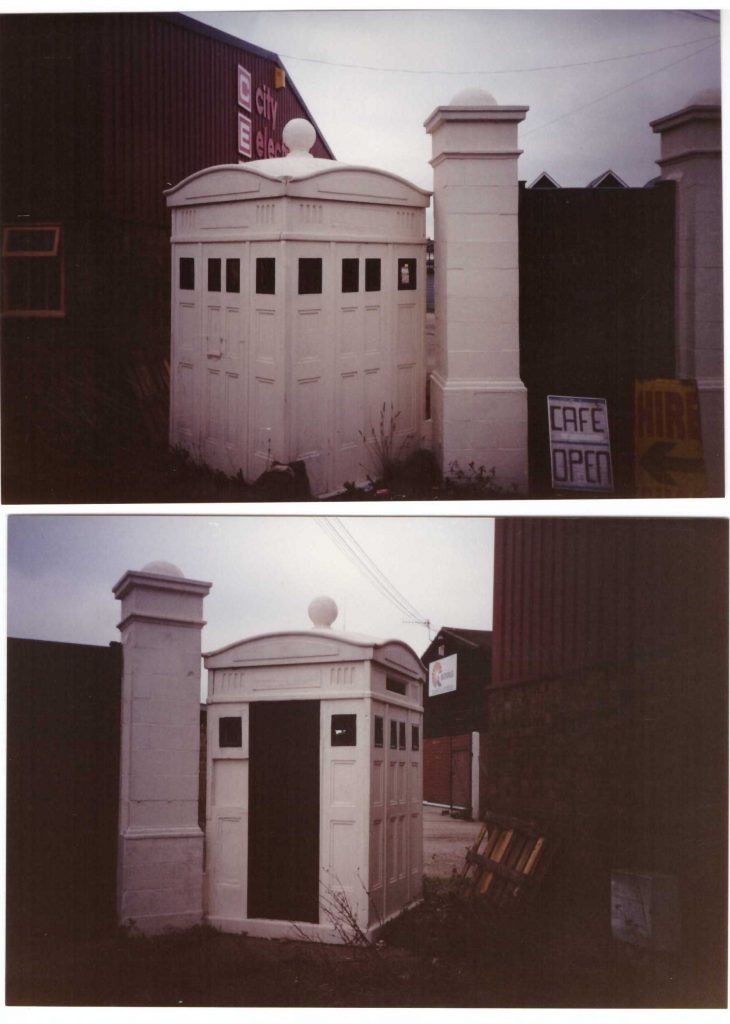
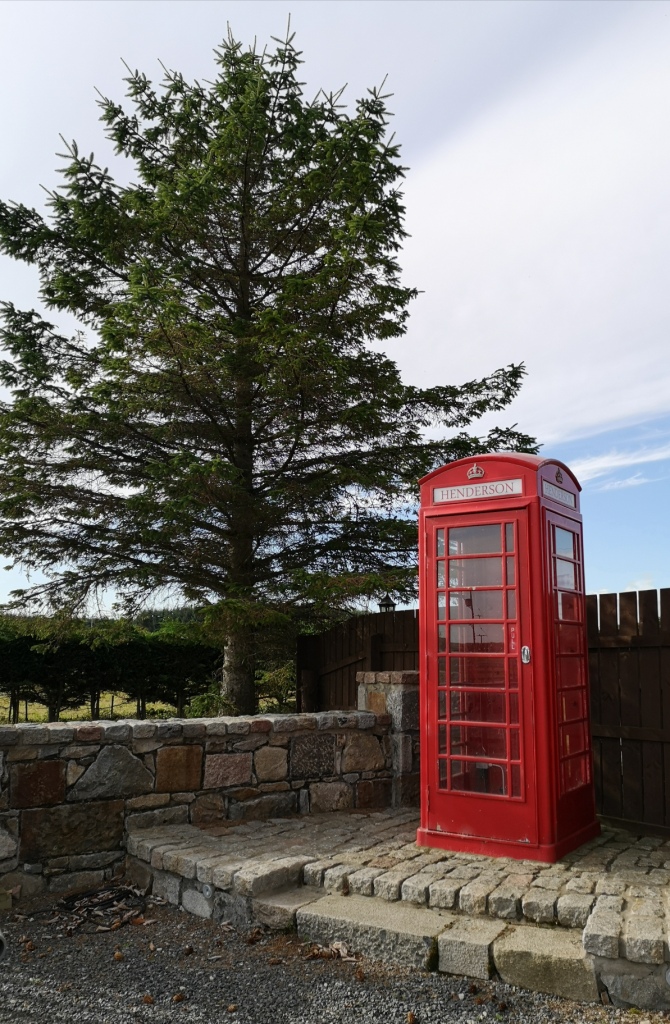
I came across this photo when going through some archaeological archives. It’s described as a Faversham gatehouse. It’s obviously on an industrial site and that appears to be ME13 7DL as the electrical supplier CEF is based there. Next time we go to Faversham, we’ll take a little detour.
In 2019 I posted a story about the Japanese wind phone – you know I love to bring to this blog, the weird and wonderful ways that phone boxes exist in our world. This beautiful idea appears to be catching on . Here is a story from the USA. (I would love to set this off where I live but I’m afraid the booth would just be vandalised.)
Marshall phone carves out space for spirituality and grief
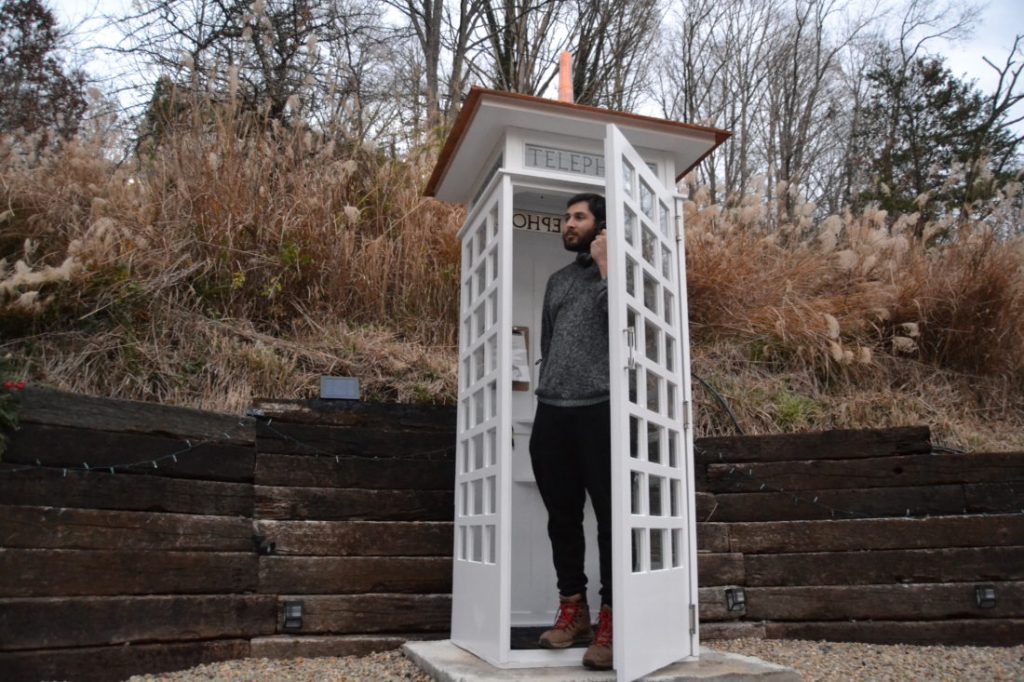
Woodfin resident Aaron Kreizman uses the Marshall wind phone to connect with a loved one. Photo by Laura Hackett.
Just off state Highway 213 in Marshall, a 1940s rotary phone sits inside a white, glass-paned phone booth, overlooking a garden and, in the distance, a ridgeline. While not physically connected to any network, the phone facilitates spiritual connections. Here, visitors can pick up the handset, “call” their lost loved ones and release whatever words they wish to communicate into the wind.
As Western North Carolina continues to grapple with the coronavirus pandemic, the wind phone’s creator, Susan Vetrone, hopes the space will offer respite and a glimmer of hope to anyone struggling with the complex emotions that accompany loss.
“People are carrying around a lot of grief,” explains Vetrone, a Marshall resident who conceptualized the project this June and oversaw the booth’s installation in October. “It’s hard to lose people you love. … I hope this helps to relieve some of that angst.”
The concept for the Marshall wind phone, says Vetrone, is based on the original “phone of the wind” in Otsuchi, Japan, created by garden designer Itaru Sasaki in 2010. Sasaki initially built the phone to cope with his grief over his dead cousin. But after a tsunami and its aftermath killed 20,000 members of his community the following year, Sasaki opened the site to the public. In the subsequent three years, the booth became a community cornerstone, receiving over 10,000 visitors.
Vetrone first heard the story of the wind phone as she was mourning her mother’s battle (and eventual passing) with Parkinson’s and dementia. “It really moved me,” she recalls. “I immediately started seeking out a way to make it happen here. I wanted it to mirror — almost exactly if it could — the Japanese phone booth that brought so many people comfort.”
Replicating the style of the original wind phone wasn’t easy. Vetrone had to sift through many red, shiny “UK- style” booths before eventually tracking down a plain wooden one, which she then painted white. “We wanted the feeling of lightness and spirituality,” she explains.
And to evoke traditional Japanese architecture, Vetrone commissioned local sculptor Steve Reed to create the booth’s ornate copper roof. She also weatherized the structure and installed solar lights inside the booth so visitors could make calls after dark.
Neighbor Sherrye Perry, who has lost both of her parents and visits the wind phone often, appreciates that it gives her the space to “say what you need to say.”
“It reminds me that there are all different ways and resources and paths to communicate with — at least in my mind — my creator and my ancestors,” Perry adds. “That we are surrounded by a great cloud of witnesses. I can’t see them, but you can feel them. And they see me, and I feel uplifted by knowing that.”
How to get there
The wind phone is open to the public at 386 Madison Heights in Marshall, about a 25-minute drive from downtown Asheville.
From Asheville, take Interstate 240 to Interstate 26 west. At Exit 19A, take U.S. Highway 25/70 north toward Marshall. Turn right on State Road 213. After 2 miles, turn left on Madison Heights Drive. The parking lot is on the right.
Posted onMarch 25, 2020|Comments Off on Community spirit
A Welsh village is trying to save its beloved red telephone box from being scrapped because it helped protect them during World War II.
The phone box in the quiet village of Bryn-y-Gwenin, near Abergavenny, South Wales,, was used to warn of air raids.
Credit: David Davies
Now the villagers want BT to save the box because of its wartime role when it was “the main point of contact” for warnings of Nazi bombing raids.
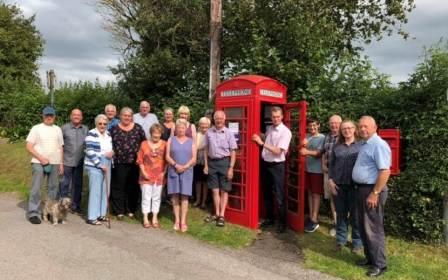
The villagers have enlisted the help of Conservative MP David Davies in their campaign to save the phone box.
Mr Davies said keeping the phone box would preserve the village’s history as well as serving a practical purpose. He said: “Mobile signal in this part of rural Monmouthshire is intermittent and very poor at best, so the public telephone box is an essential village amenity for Bryn-y-Gwenin.
“It also serves Llanddewi Skirrid and the surrounding area. With the Skirrid mountain a popular spot for walkers and cyclists, the significance of the box is paramount in an emergency.
“BT claims the phone box has had very little use over a significant period of time. Calls may well be small in number but one day that call could be very important and potentially life-saving.”
Previous plans to decommission the box were successfully overturned in 2016 following a similar local campaign.
Resident Paul Webb said villagers “cherished” the box, which bears the Tudor Crown of King George VI.
“One of our villagers, Richard Cox, cleans it on a weekly basis and repaints it when necessary.” he said.
“The box has always been a proud landmark at the entrance to our village. It is an iconic part of British heritage yet sadly, these red telephone boxes are getting more and more scare in the countryside.
“It has been stated in the past that if the phone itself was removed but the box remained then the villagers would be prepared to have a defibrillator installed as it would be a very strategic place for one to be available.”
The phone box is a K6 model, designed to commemorate the silver jubilee of King George V, and entering production in 1936.
It was originally connected to the village post office via a party line.
On Twitter, Mr Davies posted a video of himself at the phone box and surrounded by residents. He said: “This phone box played a small role in defending Britain during WW2. It is being lovingly cleaned & maintained by a local resident. After decades of loyal@service @bt_uk want to scrap it.”
BT has launched a consultation period to determine the phone box’s future.
A spokesman for BT said: “Most people now have a mobile phone and calls made from our public telephones have fallen by around 90 per cent in the past decade.
“We consider a number of factors before consulting on the removal of payphones.”
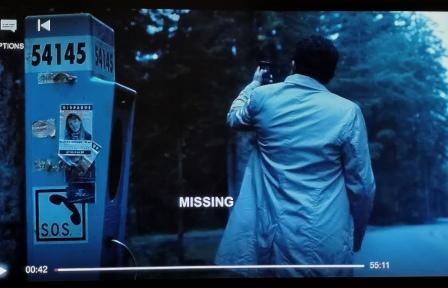
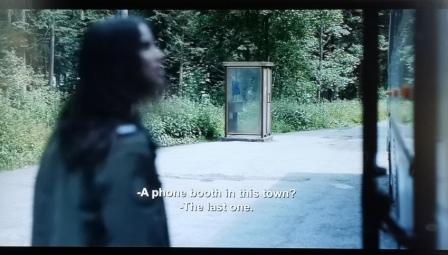
In English the show is called ‘Black Spot’ but although my French is not so good even I know ‘Zone Blanche’ translates as ‘White’ zone. It refers to the lack of communication signals in the town and forest. I find it curious that languages can refer to the same occurrence with a phrase that uses opposite terms.
I love this shot from Tin Star. There was no real need in the story line for this scene but the producers put it in anyway. Local art and phone boxes create powerful images.