BT installed its 100,000th payphone at Dunsop Bridge, Lancashire in 1992 and included a plaque to explain its significance. It reads: “You are calling from the BT payphone that marks the centre of Great Britain.”
In fact, the phone is 4.2 miles (6.8 km) from the true centre. Postmaster and shop owner Phil Woodhead said the town did not capitalise on its status.
“There is only that payphone really… we haven’t put up big signs or anything like that. If this was a bigger town with more shops, then maybe we would do something. But because we are so small, there is really no-one to push it.”
Posted onMarch 14, 2016|Comments Off on Mojave Phone Booth
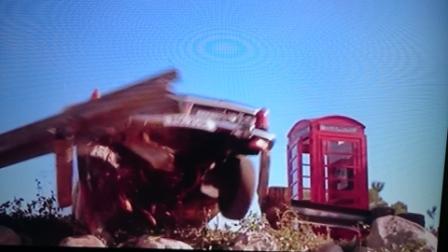
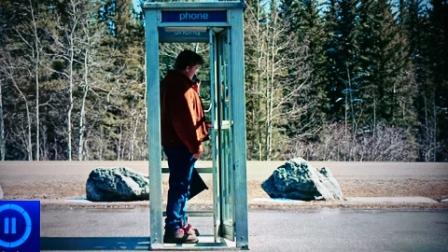
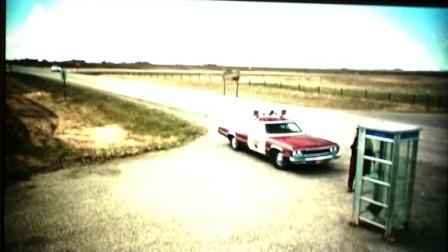
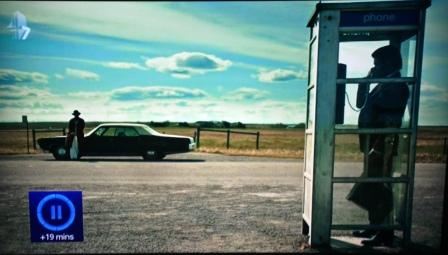
I listen to a podcast called 99% Invisible. It’s an American series I have been onto for a couple of years – although I only listen in spasmodically. Podcast no. 202 is title ‘Mojave Phone Booth’. It has led me to a movie I didn’t know about Mojave Phone Booth (2006) and the Wikipedia page on the artefact itself – you guessed it, a phone box in the Mojave desert.
This goes a long way to proving that I am not alone in my fascination for phone boxes.
Local phone box is a place to lay tribute to a much loved village goose.
From The Telegraph, Sophie Jamieson, 25 February 2016.
Murder most fowl: much-loved village goose shot dead in mystery attack. A goose which had been a treasured part of the community in Sandon for over a decade was shot dead
In reading ‘Island’ by Aldous Huxley I came across the paragraph below. The speaker is talking about a ‘Mutual Adoption Club’ and comparing it to Western society. On Pala (the island the title refers to) whenever the parental home becomes too unbearable the child is allowed to migrate to one of its other homes within its MAC. A MAC consists of from 15 to 25 assorted couples and everyone in the club adopts everyone else. An inclusive, voluntary family (this is one of the good ideas of the book but there are a few hoopy ones).
Things are a great deal better in your part of the world – better, but still quite bad enough. You escape the state-appointed baby-tamers; but your society condemns you to pass your childhood in an exclusive family, with only a single set of siblings and parents. They’re foisted on you by hereditary predestination. You can’t get rid of them, can’t take a holiday from them, can’t go to anyone else for a change of moral or psychological air. It’s freedom, if you like – but freedom in a telephone box.*
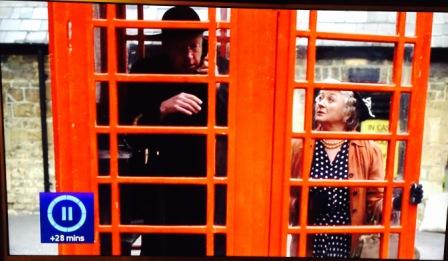
I’ve become very fond of Father Brown. He’s a follow up to Miss Marple so what’s not to love. This scene cracked me up – another fab use for a phone box. Make a phone call to a cross-dressing club and when you give the right code phrase the door in the wall behind the phone box will open and let you into the club.
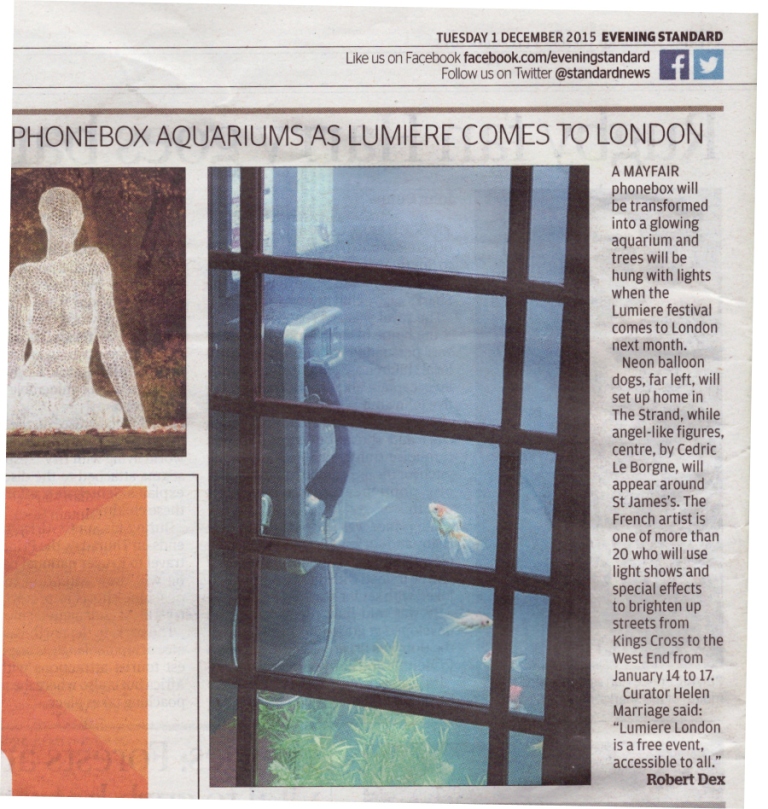
A Mayfair phone box will be transformed into a glowing aquarium and trees will be hung with lights when the Lumiere festival come to Lndon next month. Neon balloon dogs will set up home in the Strand, while angel-like figures, by Cedric Le Borgne, will appear around St James. The French artist is one of more than 20 who will use light shows and special effects to brighten up streets from Kings Cross to the West End from January 14 to 17. Curator Helen Marriage said:
Lumiere London is a free event, accessible to all.
This isn’t new to this blog, as such, but good to see the phone box still warrants news articles. Here reproduced from yesterday’s Guardian, Maev Kennedy 23 November 2015.
Sir John Soane: how tomb for architect’s wife inspired the red telephone box
When Eliza Soane died 200 years ago, it changed the life of her architect husband Sir John Soane – and it changed the British streetscape through the strange afterlife of the tomb he designed for her, which inspired the design of the iconic red telephone box.
Soane never got over his wife’s death on 22 November 1815 although he lived until 1837. He was one of the most renowned architects of his day – creator of monumental public buildings including the Bank of England, churches, and country houses, as well as an avid collector of fragments of older buildings including Old St Paul’s cathedral. He blamed her death on the shock of discovering that their son George was the author of some malevolent anonymous reviews of his work.
Her tomb, which became the family vault, was raised over her grave in Old St Pancras churchyard in 1816, and inspired the Giles Gilbert Scott telephone kiosk. Scott knew the tomb well as a trustee of theSir John Soane’s Museumfor 35 years, and his 1920s creation is now an endlessly imitated landmark in British design.
Staff of the museum in Lincoln’s Inn Fields in London, the family’s home and his workshop, have commissioned a specially designed wreath to lay on her grave in Old St Pancras churchyard. Helen Dorey, acting museum director, said: “I regard this primarily as a private pilgrimage which we are doing because it is the right thing to do to honour our founder and his family.”





Mojave Phone Booth
I listen to a podcast called 99% Invisible. It’s an American series I have been onto for a couple of years – although I only listen in spasmodically. Podcast no. 202 is title ‘Mojave Phone Booth’. It has led me to a movie I didn’t know about Mojave Phone Booth (2006) and the Wikipedia page on the artefact itself – you guessed it, a phone box in the Mojave desert.
This goes a long way to proving that I am not alone in my fascination for phone boxes.
Comments Off on Mojave Phone Booth
Posted in Comment, Geography, Media
Tagged cinema, desert, USA