Category Archives: News

Online exhibition celebrates telephones in literature

I thought that my blog would become somewhat irrelevant over the years, as focusing on a piece of technology of the past would mainly be of interest to social historians. Yet our collected response to Covid-19 has proved me wrong. Communication is still a key feature of the make up of human beings. We all need to connect to someone. Yes, the technology has changed, but it’s still technology being put to the same use – to maintain contact. A current online exhibition seems to prove my point.

From The Guardian, Steven Morris, 17 November 2020.

“They can be objects of romance or harbingers of doom. They can provide plot twists, shocks, horror, comedy or character. Now the role of the telephone in literature, from the 19th century to the present day, is being celebrated in an online exhibition, Crossed Lines.

Readers of books, plays and poems were invited to send in their favourite references to telephones in literature, and almost 100 examples, from the earliest models to smartphones, were submitted from across the world…”

For the full article go to The Guardian – https://www.theguardian.com/artanddesign/2020/nov/17/milkman-to-mark-twain-online-exhibition-celebrates-telephones-in-literature

Some things can’t be replicated

‘Thames Town’, is a town in China that is replica of perceived UK architecture. It naturally includes an iconic red box. Frankie Boyle, in ‘New World Order’, noted that to make it more authentic someone would have to piss in the phonebox. Sad but true.

For more details and a photo of their version of the red phone box go to https://www.beijing-visitor.com/china-city-guides/shanghai/thames-town.

Covid-19 lockdown and the phone box

This article in The Guardian showes how relevant phone boxes still are to communities in the modern world. (A small piece of good news in a time when 98% of news articles just bring me down.)

Drum rolls, bread rolls and rolling wheels – the upside of lockdown

It is heart warming to see every aspect of society transformed to join the effort against coronavirus, with Harry Potter buses turning into NHS shuttles, an old red phone box becoming a food hub, and an ancient water mill brought back into action to tackle the flour shortage…

A disused red phone box has been transformed into a mini food hub, stocking groceries and other essentials for residents struggling with the coronavirus lockdown. Muthill, a village in Perth and Kinross, Scotland, is home to 675 residents. Corinna Robertson and Susan Crawford decided to set up the “take what you need” service after realising just how badly the lockdown had hit some people.

“We realised this is worse than we thought. People are off work and have no income and it’ll take a while for them to get money through,” said Robertson, a 52-year-old garage worker who was recently furloughed.

For the full article go to The Guardian – https://www.theguardian.com/news/2020/apr/15/drum-rolls-bread-rolls-and-rolling-wheels

Community spirit

From The Telegraph, Callum Adams, 18 August 2019.

A Welsh village is trying to save its beloved red telephone box from being scrapped because it helped protect them during World War II.

The phone box in the quiet village of Bryn-y-Gwenin, near Abergavenny, South Wales,, was used to warn of air raids. Now the villagers want BT to save the box because of its wartime role when it was “the main point of contact” for warnings of Nazi bombing raids.

The villagers have enlisted the help of Conservative MP David Davies in their campaign to save the phone box. Mr Davies said keeping the phone box would preserve the village’s history as well as serving a practical purpose. He said: “Mobile signal in this part of rural Monmouthshire is intermittent and very poor at best, so the public telephone box is an essential village amenity for Bryn-y-Gwenin.

“It also serves Llanddewi Skirrid and the surrounding area. With the Skirrid mountain a popular spot for walkers and cyclists, the significance of the box is paramount in an emergency.

“BT claims the phone box has had very little use over a significant period of time. Calls may well be small in number but one day that call could be very important and potentially life-saving.”

Previous plans to decommission the box were successfully overturned in 2016 following a similar local campaign. Resident Paul Webb said villagers “cherished” the box, which bears the Tudor Crown of King George VI. “One of our villagers, Richard Cox, cleans it on a weekly basis and repaints it when necessary.” he said.

“The box has always been a proud landmark at the entrance to our village.  It is an iconic part of British heritage yet sadly, these red telephone boxes are getting more and more scare in the countryside.

“It has been stated in the past that if the phone itself was removed but the box remained then the villagers would be prepared to have a defibrillator installed as it would be a very strategic place for one to be available.”

For the full article go to The Telegraph – https://www.telegraph.co.uk/news/2019/08/18/villagers-fight-save-wwii-phone-box/

Interdisciplinary artists

From The Guardian, Oliver Basciano, 10 December 2019.

The article begins with an image still from the film ‘Otolith II’ (2007) [No IMBD link available.]

For the full article go to The Guardian – https://www.theguardian.com/artanddesign/2019/dec/10/artists-assemble-how-collectives-took-over-the-art-world

The Otolith Group was founded in London by Anjalika Sagar and Kodwo Eshun in 2002. They are interdisciplinary artists working internationally for over two decades with a pluralistic body of forms including, installation, publication, performance, photography and video. Their practice observes methods of research that manifest as distinct cosmogonies that see and listen across media. Sounds, texts and images emerge in dialogue with the cultural worlds and communities of the global majority who form the continents and countries of the global south and its diasporas.

WeWork removes thousands of phone booths

From Zero Hedge, Tyler Durden, 15 October 2019.

It isn’t just WeWork’s now-pulled IPO that’s toxic at the company: according to a Business Insider report, the company emailed its tenants on Monday telling them that there was “potentially elevated levels of formaldehyde” in phone booths throughout WeWork offices in the U.S. and Canada. Why they used the word potential is unclear – according to the report, the company admitted that “tests for high levels of formaldehyde came back positive late last week”.

The email stated that the company was removing 1,600 phone booth from locations that “may be impacted” in addition to 700 other booths that have yet to be tested for formaldehyde. At some WeWork spaces on Monday, there were taped signs reading: “CAUTION: DO NOT USE” over the phone booths.  The company stated in its email that it had received complaints of “odor and eye irritation”. The EPA says that formaldehyde can cause respiratory symptoms and eye, nose and throat irritation. 

Colleen Wong, a tenant at WeWork’s Rosslyn location in Arlington, Virginia said: “I always noticed, from the first time I entered a phone booth, a strong chemical odor. I assumed it was a new building / equipment type smell. Kind of like glue or a new car.”

“They had a chemical smell, like when you get something new in the mail,” a WeWork member from Minneapolis told Bloomberg. WeWork says the high formaldehyde levels are the fault of the manufacturer of the phone booths. 

For the full article go to Zero-Hedge – https://www.zerohedge.com/technology/wework-removes-thousands-phone-booths-due-elevated-formaldehyde

Tumbling installation refurbished

This installation has been mentioned before on the blog but it’s now had a refurbishment.

From Secret London, by Georgie Mortimer, 14 Feb 2025.

The ‘Out of Order’ installation, which consists of twelve tumbling telephone boxes, has been revealed after a bit of a zhuzh up. Located on Kingston’s lovely Old London Road, the sculpture has been a landmark since it was first installed in 1989.  The piece was created by David Mach, one of the UK’s most successful artists and a former lecturer at Sculpture School in Kingston. He’s known for his large scale collages and sculptures all over the world, but this one is particularly special to him. He says of the installation’s refurb: 

“I’m very happy to see Out of Order being refurbished. It’s one of my best outdoor sculptures. I love these boxes and isn’t it funny that even in these times and although they were removed from the British landscape, I feel they still bind us as a nation.”

The Wind Phone

I’ve featured this idea before on the blog but it’s worth revisiting. This wonderful story comes from the BBC World Service, 7 June 2019.

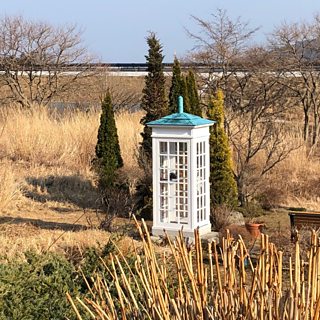
When an earthquake and tsunami struck Japan in 2011, 30ft (9.14m) waves obliterated coastal communities. The small town of Otsuchi lost everything including 2000 residents. One resident, Itaru Sasaki, was already grieving his cousin before the tsunami hit. He had the idea of nestling an old phone booth on the windy hill at the bottom of his garden which overlooked the Pacific Ocean. This would be a place he could go to speak to his cousin – a place where his words could ‘be carried on the wind.’ The white, glass-paned booth holds an old disconnected rotary phone. He called it his Wind Phone.

In the aftermath of the terrible tsunami, as word of the phone spread, it became a pilgrimage site for those who had lost loved ones. In the sanctuary of the booth they would dial old phone numbers and talk to their loved ones. Interpreter and journalist Miwako Ozawa visited Otsuchi in the weeks after the tsunami. In this programme she returns for the first time since 2011 to visit the phone and find out how it has helped people to cope with their grief.

We meet some of those who regularly visit the phone and we hear their stories and listen in to their phone calls. In many ways the wind phone typifies a very Japanese relationship with nature and death and with the invisible forces that connect us all. As the residents of Otsuchi face the slow progress of rebuilding their town and the frightening reality of future extreme weather, the wind phone is a reminder of those losses that won’t be forgotten.

Presenter: Miwako Ozawa

Producer: Sarah Cuddon

Photo: The wind phone

Photo: The wind phone.

Man who was living in Greenhithe telephone box ‘receiving the help he needs’

An update on a previous story…

From Kent Online, Jenna Dobbs, 25 April 2019.

A man who has been living in a telephone box in Station Road, Greenhithe, is “receiving the help he needs”. The update, from Kent County Cllr Peter Harman, follows concern for the rough sleeper, thought to be in his early 20s. He has been working to support the man alongside the Revs Carol and Andrew Avery, of St Mary, Greenhithe and St Mary, Stone.

For the full article go to Kent Online – https://www.kentonline.co.uk/dartford/news/telephone-box-man-moved-on-203377/

Concern for man living in telephone box in Greenhithe

From Kent Online, by Jenna Dobbs, 11 April 2019:

Community members are trying to support a homeless man who has been living in a phone box. The rough sleeper, thought to be in his early 20s, has been staying in the makeshift shelter in Greenhithe after being homeless for about a month. His whereabouts, which were first revealed on a community Facebook page, prompted comments from concerned residents.

For the full article go to Kent Online – https://www.kentonline.co.uk/gravesend/news/concerns-for-man-living-in-phone-box-202525/